Accelerating DPI execution for 25+ countries
Showcasing the people we help, the places we've worked, and the services that we provide.

Showcasing the people we help, the places we've worked, and the services that we provide.
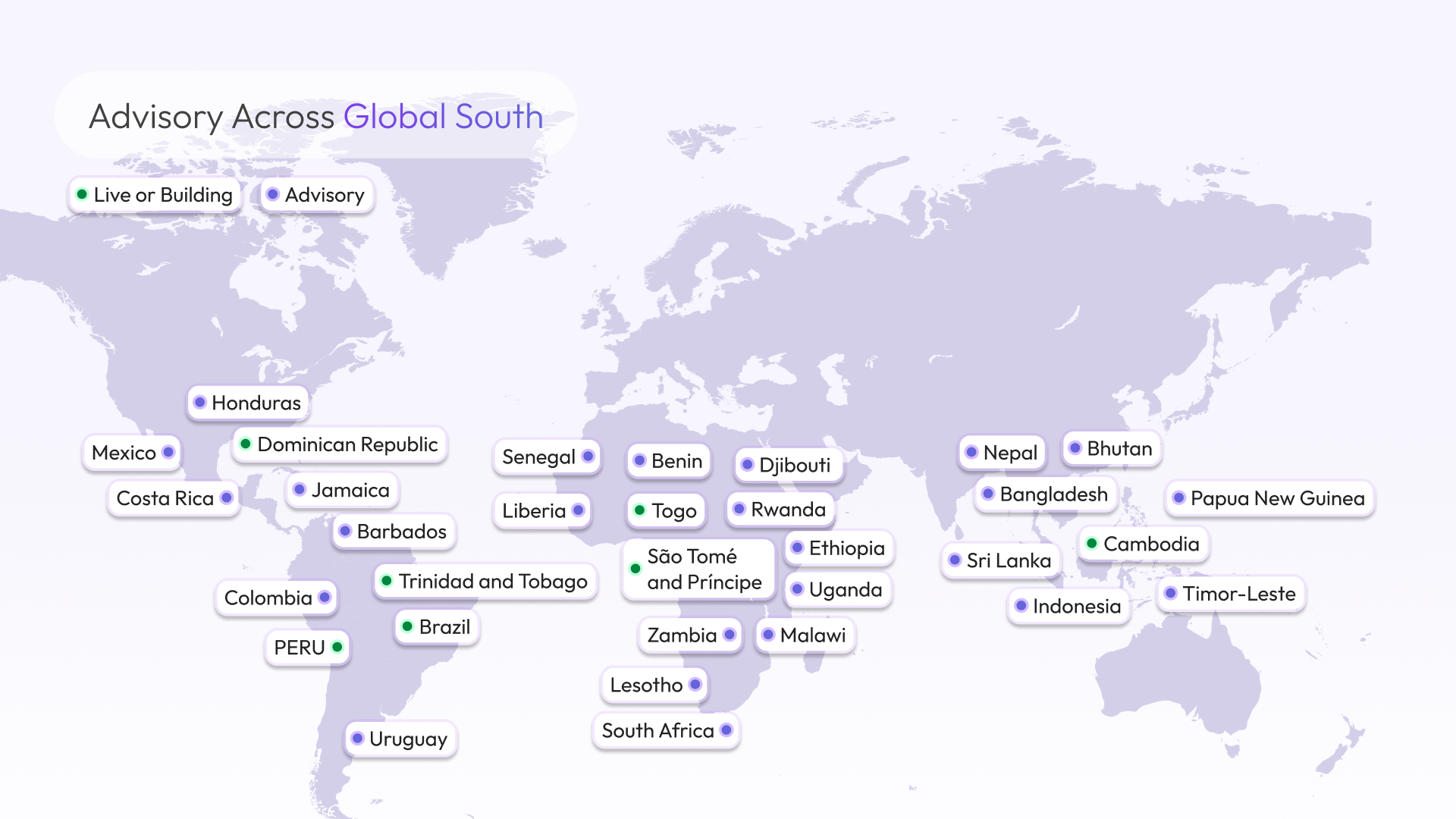

Pro bono advisory services and curated artefacts in line with global best practices addressing population‑scale challenges for equitable national growth.

Showcasing the people we help, the places we've worked, and the services that we provide.
Latin America and the Caribbean remains the most unequal region in the world, with fragmented systems limiting service delivery and growth.
CDPI has worked with one in three countries across the region to address these gaps through practical DPI advisory and implementation. Rather than building isolated apps, we focus on interoperable foundations that support multiple use cases.
In Peru , we supported the shift from a standalone digital ID to a broader verifiable credentials ecosystem with multiple wallets, issuers, and verifiers. Citizens can now use digital credentials for services ranging from license renewal to entry at Machu Picchu.
In Trinidad and Tobago , we are implementing a secure data-sharing framework that allows citizens to share credentials digitally, simplifying degree verification, migration permits, and business registration.
In the Dominican Republic , we advised on a whole-of-government DPI strategy, helping build shared payment rails for social assistance, emergency transfers, and microcredit, while strengthening data-sharing systems and business digital identity.
We also support Brazil in expanding verifiable credentials for farmers and other use cases, Mexico in advancing a national health ID, and Jamaica in simplifying tax compliance.
Beyond country-specific advisory, CDPI is actively driving regional integration. We provide strategic support to RedGealc, run technical hackathons to spur local innovation, and advise on the IDLAC initiative to ensure that digital identity standards are harmonized across borders. Our goal is to foster a cohesive regional network where digital solutions in one country can be easily adapted and scaled by its neighbors.
Across Africa, progress in digitalization is often constrained by fragmented systems and limited interoperability. DPI is emerging as a way to address these challenges by enabling shared, reusable building blocks that can scale across sectors.
CDPI is working with governments, regional institutions, and development partners to support the design and implementation of these foundational systems in a way that reflects local priorities and constraints. This includes advising on digital identity, data sharing, and trust infrastructure, as well as supporting the rollout of verifiable credential ecosystems in sectors such as education and social protection (e.g.,Togo , Benin ). CDPI also contributes to national roadmaps (South Africa ,Sénégal ). CDPI also helps identify high-impact use cases to drive adoption, and supports ecosystem coordination and capacity building with partners such as the World Bank, AfDB, UNDP, Gates Foundation and Co-Develop.
While the Asia and Pacific region has invested heavily in digital infrastructure over the past twenty years, the full realization of digital dividends remains hindered by fragmented services, duplication, and underlying weaknesses in both hard and soft systems. To overcome these barriers and maximize the impact of digital investments, Digital Public Infrastructure (DPI) has emerged as a strategic solution designed to eliminate systemic inconsistencies and drive more unified, economy-wide growth. CDPI is working with countries, multilateral partners, private sector ecosystems, to facilitate greater acceleration of DPI in the region.
Our range of technical advisory inputs in the region include, provided advisory and co-created interoperable foundations such as registry and SSO that can be reusable and scalable in multiple use cases and sectors (Cambodia and Indonesia ).
We provided advisory notes on digital ID strategy, use cases, and rollout, factoring into respective countries stages and local contexts (Sri Lanka , Papua New Guinea , Cambodia ).
We also peer reviewed DPI-led digital government blueprints, providing recommendations on rapid deployment options using +1 approach, ways to anticipate frequent design architecture errors from the start (Nepal, Bhutan).
We also supported the DPI regional ecosystem effort in coming up with better understanding and landscapes of the regional’s challenges and opportunities by joining forces in peer review mechanism as well as capacity building efforts initiated by partners including ADB, Co-Develop, Gates Foundation, UNDP, the World Bank, and many more.



8+ countries are building DPI the DaaS way.
Learn more
ORCHESTRATION
We work with technology solution providers to strengthen offerings for countries.








We work with funders and the development sector for global DPI advocacy and implementation.











We work with researchers to drive thought leadership and conduct impact evaluations of DPI






A curated collection from DPI builders
Equipping global builders with the frameworks and technical blueprints needed to scale inclusive DPI. From strategic white papers to bite-sized implementation guides, find everything you need to start.
Explore the Resource Library